
PLANNING FOR THE FUTURE OF WUSD

OPERATIONAL REFERENDUM
Tuesday, November 3, 2026
The Whitewater Unified School District is committed to helping every student succeed, now and in the future.
On Tuesday, November 3, 2026, voters in our community will decide whether to approve a proposed four-year, non-recurring operational referendum to support our educational programs, services, staff, and other day-to-day operating expenses.
If approved, the referendum would allow WUSD to exceed its state-imposed revenue limit by $5.5 million annually for four years, beginning in the 2027-28 school year and ending after the 2030-31 school year.
The funding would replace the district’s current four-year, non-recurring operational referendum, which voters approved in 2022 and that’s scheduled to expire at the end of the 2026-27 school year. The proposed referendum would be $1.1 million over the current amount.

View a Presentation on the Referendum
In this video, Superintendent Samuel Karns shares information on operational referendum question that will appear on the ballot Tuesday, November 3. A version with Spanish close captions is available at this link.

Addressing WUSD's Operational Needs
Like many Wisconsin school districts, WUSD is facing financial challenges caused by rising costs and the state’s inequitable school funding system.
-
Wisconsin school districts are primarily funded through state aid and local property taxes.
-
State law limits the amount of revenue districts can receive through these sources.
-
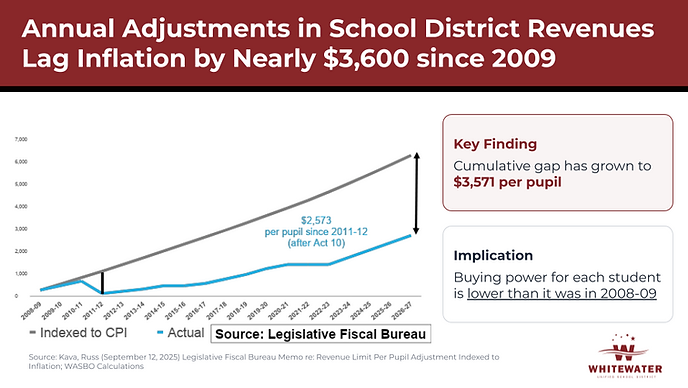
The revenue limit system was established in 1993, and allowable revenue increases have not consistently kept pace with inflation and rising operating costs.
At the same time, costs continue to rise for utilities, fuel and equipment for buses, health insurance, property and liability insurance, curricular resources, maintenance, wages, and benefits. Student needs have also grown in areas such as special education, intervention, mental health, individualized instruction, and other student support services.
Many of these services are required, but are not fully funded by the state or federal government.


The Proposed Solution
If approved, the operational referendum would provide additional revenue to help WUSD:
-
Sustain critical operations and student support services
-
Maintain current student programming and academic opportunities
-
Offer competitive compensation to attract and retain staff
-
Preserve individualized instruction and intervention services
-
Maintain reasonable class sizes and student-to-staff ratios
-
Support students with disabilities and students with unique learning needs
-
Continue work connected to the district’s strategic plan
Although the referendum would not restore every program or service the district has offered in the past, it would help maintain key components of our operations as costs continue to rise.

Property Tax Impact
An approved referendum would increase the school district’s mill rate by approximately $0.40 per $1,000 of assessed property value, or about $120 per year for a home valued at $300,000.


Frequently Asked Questions
What are the district’s operational needs?
Like many Wisconsin school districts, WUSD is facing financial challenges caused by rising costs and the state’s inequitable school funding system.
Wisconsin school districts are primarily funded through state aid and local property taxes. State law limits the amount of revenue districts can receive through these sources. The revenue limit system was established in 1993, and allowable revenue increases have not consistently kept pace with inflation and rising operating costs.
At the same time, costs continue to rise for utilities, fuel and equipment for buses, health insurance, property and liability insurance, curricular resources, maintenance, wages, and benefits. Student needs have also grown in areas such as special education, intervention, mental health, individualized instruction, and other student support services.
Many of these services are required, but are not fully funded by the state or federal government.

How does Wisconsin’s school funding system impact districts like WUSD?
Wisconsin school districts are primarily funded through a combination of state aid and local property taxes. Each district also has a revenue limit, created by the state school funding formula. The limit, which was established in 1993 and has not kept pace with increasing costs and inflation, caps the amount of money a district can receive through state aid and local property taxes.
WUSD’s revenue limit authority is primarily controlled by two things: (1) student enrollment and (2) state-approved adjustments. If revenues had kept pace with inflation since 2009, school districts like ours would receive approximately $3,500 more per student.
Furthermore, in 2025-26, $357.5 million was reduced from general public school aid to give to private voucher schools. More than 70% of Wisconsin public school districts saw a reduction in their school aid as a result.
What is fund balance and why should the district not rely on it to balance its budget?
Fund balance is the difference between a school district’s assets and liabilities at a given point in time. It serves as a financial reserve that helps the district manage cash flow, respond to unexpected expenses, and maintain financial stability.
A healthy fund balance can also help a district limit short-term borrowing and the associated interest costs.
While fund balance can be used strategically to address a temporary budget shortfall, it is not a sustainable solution to an ongoing operating deficit. Fund balance is a finite, one-time resource. If WUSD spends more than it receives in recurring revenue each year, continually drawing from fund balance would reduce those reserves until they are depleted.
The district must balance the short-term use of fund balance with the need to maintain adequate reserves for cash flow, unforeseen expenses, and other financial needs. An operational referendum, by comparison, can provide additional revenue authority to support ongoing district operating expenses within Wisconsin’s revenue limit system.

What has been the district’s enrollment trend over the past decade?
WUSD's enrollment has fluctuated over the past several years, but has experienced an overall decline. Enrollment stood at 1,927 students in 2017-18, reached a high of 1,997 students in 2019-20, and is 1,830 students in 2025-26.
Overall, this represents a decrease of 97 students, or about 5%, from 2017-18 to 2025-26. More recently, enrollment has declined for three consecutive years, from 1,986 students in 2022-23 to 1,830 students in 2025-26.
Because enrollment plays an important role in Wisconsin’s school funding system, changes in student enrollment can affect the amount of revenue available to the district.

How has the district worked to control costs?
WUSD has taken a number of steps to reduce costs and carefully manage available resources.
For the 2026-27 school year, the district identified approximately $798,861 in budget reductions. These adjustments include reductions to non-grant expenditures, staffing and staff additives, software and subscriptions, substitute costs, paraprofessional positions, and elementary classroom sections.
Specific reductions include a 10% decrease in certain budget categories, leaving a high school special education teaching position unfilled, reducing several instructional and special education paraprofessional positions, and reducing one section each in first grade at Lakeview and second grade at Lincoln. The district also identified savings through software and subscription changes.
After accounting for a new $90,000 human resources position, these changes result in approximately $708,861 in net savings for 2026-27.
For a complete list of the district’s 2026-27 budget adjustments and estimated savings, view the full Budget Reductions & New Revenues Summary Sheet.
While these and other cost-saving measures have helped delay the need for additional funding, they are no longer enough to offset rising costs, limited state revenue, and growing student needs.
What happens if voters approve the referendum?
If voters approve the referendum this November, the district will be authorized to levy the additional funding approved through the ballot measure.
This would allow the district to:
-
Sustain critical operations and student support services
-
Maintain current student programming and academic opportunities
-
Offer competitive compensation to attract and retain staff
-
Preserve individualized instruction and intervention services
-
Maintain reasonable class sizes and student-to-staff ratios
-
Support students with disabilities and students with unique learning needs
-
Continue work connected to the district’s strategic plan
Referendum funding would be part of the district’s four-year financial plan. WUSD would continue reviewing its budget each year for additional reductions and cost savings while working to maintain student programs and services.
What could happen if the referendum is not approved?
Without additional operational funding, WUSD would need to make further budget reductions.
Potential impacts could include larger class sizes, reduced individualized instruction, fewer student support services, and limited resources for students with disabilities or unique learning needs.
Reductions could also affect academic programs, enrichment opportunities, technology upgrades, specialized services, extracurricular and co-curricular opportunities, and student-to-staff ratios.
Additionally, budget constraints could affect the district’s ability to offer competitive compensation and attract and retain teachers and support staff.

How would an approved referendum affect property taxes?
An approved referendum would increase the school district’s mill rate by approximately $0.40 per $1,000 of assessed property value, or about $120 per year for a home valued at $300,000.
Are operational referendums common in Wisconsin?
Yes. Nearly 90% of Wisconsin school districts have attempted operational referendums. Over the past decade, more than half of Wisconsin's school districts have received voter approval through successful operational referendums to exceed their revenue limits.
Why did the board select $5.5 million annually for the referendum amount?
The board considered several funding amounts as it reviewed how to address the district’s projected budget shortfall.
For each option, the board considered how much additional revenue the district would receive, what budget reductions would still be necessary, the estimated impact on taxpayers, and how reductions could affect student programs and services.
The board selected $5.5 million annually for four years as the amount that would provide additional operating revenue while still requiring the district to make budget reductions.
Why is the referendum limited to four years?
The proposed referendum is non-recurring, meaning the district’s authority to collect the additional $5.5 million annually would expire after four years.
If the district needed additional revenue beyond that period, voters would need to approve another referendum.
The four-year period also gives the district time to continue reviewing its budget, enrollment, expenses, and long-term financial needs while making additional reductions and identifying cost savings where possible.
Why is WUSD addressing operational and capital needs separately?
WUSD is addressing its operational and capital needs separately rather than asking the community to consider both at the same time. This allows the district to plan for operational and facility needs on separate timelines and provide the community with information about each.
The question on the November 3 ballot is an operational referendum. If approved, it would provide funding for day-to-day district expenses. It is not a capital referendum, which is for building projects.
What is the difference between an operational and capital referendum?
Wisconsin school districts may ask voters to consider different types of referendums depending on the need being addressed.
An operational referendum provides funding for the ongoing, day-to-day costs of running a school district. This can include salaries and benefits, student programs and services, classroom resources, utilities, fuel and equipment for buses, maintenance, and other operating expenses.
A capital referendum provides funding for major building and facility projects. This can include renovations, additions, new construction, major building-system improvements, and other long-term facility needs.
The question on the November 3 ballot is an operational referendum
What is WUSD’s history with referendums?
WUSD voters approved a four-year, non-recurring operational referendum in 2022. That funding is set to expire at the end of the 2026-27 school year.
Whitewater Unified School District voters have considered and approved several operational and capital referendum questions over the past 25 years.
When is election day?
Election Day is Tuesday, November 3, 2026.
Where can I vote?
District residents can vote at their designated polling location. For information about polling locations, voter registration status, and other voting information, visit https://myvote.wi.gov.
Can I vote absentee?
Eligible Wisconsin voters may vote absentee. Deadlines and requirements apply. For current information about requesting and returning an absentee ballot, visit https://myvote.wi.gov/en-us/Vote-Absentee-By-Mail.
How do I register to vote?
Eligible residents can find voter registration information, requirements, and applicable deadlines through the MyVote Wisconsin voter registration page: https://myvote.wi.gov/en-us/Register-To-Vote.
What is the exact question that will appear on the ballot?
Voters will find the following question on the ballot Tuesday, November 3:
Shall the Whitewater Unified School District, Walworth, Jefferson and Rock Counties, Wisconsin be authorized to exceed the revenue limit specified in Section 121.91, Wisconsin Statutes, by $5,500,000 per year for four years, beginning with the 2027-2028 school year and ending with the 2030-2031 school year, for non-recurring purposes consisting of the following: maintaining student support and mental health services, maintaining comprehensive instructional and co-curricular programs, and maintaining technology, safety, and facilities infrastructure?

Resources on Wisconsin School Funding
Video: Wisconsin School Funding Explained (Wisconsin DPI)
Video: Wisconsin School Funding (WASBO/WSPRA)
Fact Sheet: Wisconsin Education Funding Basics (Wisconsin Public Education Network)
Why Wisconsin needs to find a fix for its public school funding formula (Spectrum News)